
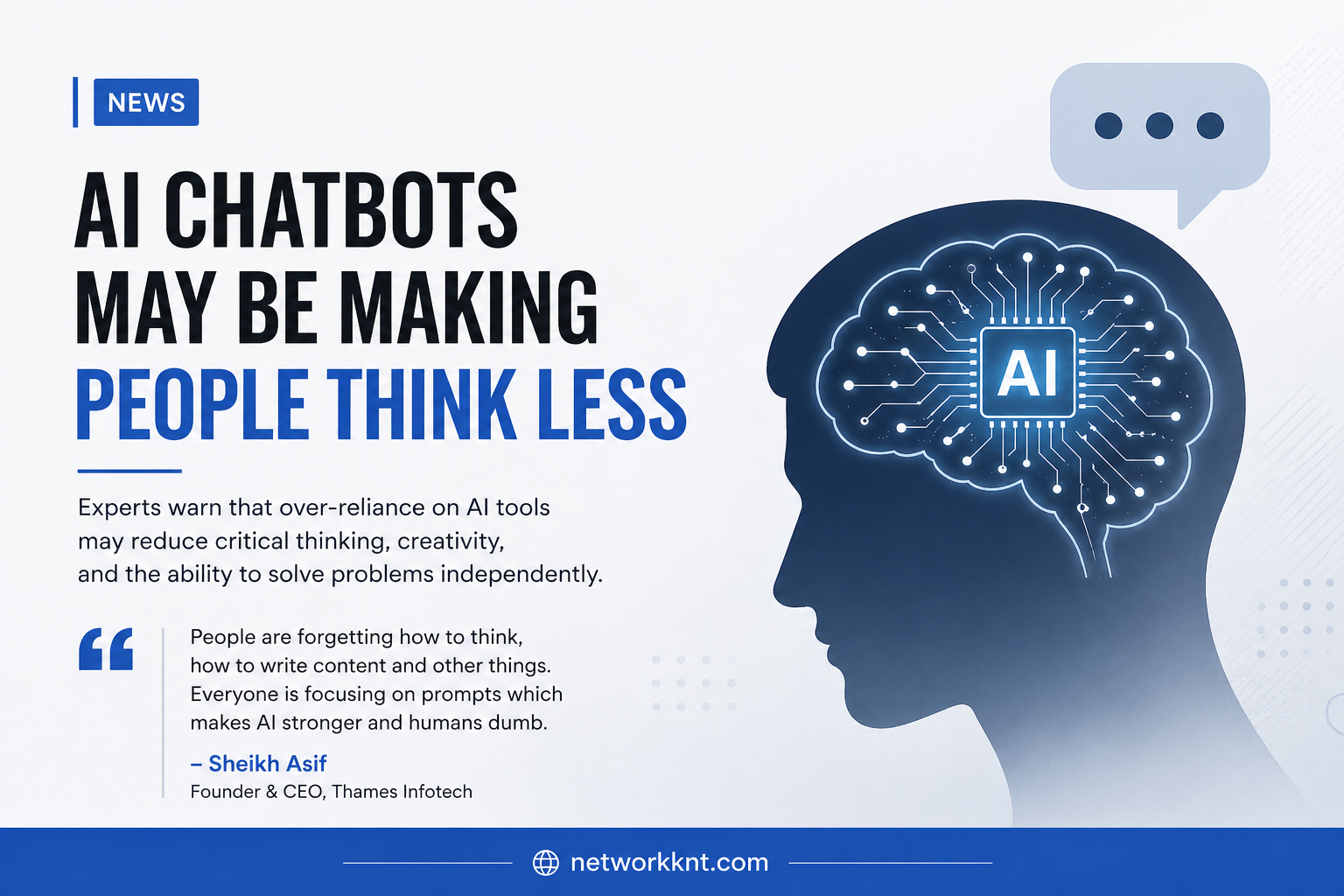

A growing body of research suggests that frequent use of artificial intelligence tools may be quietly changing how people think, learn, and create. While AI chatbots have become a part of everyday life helping with writing, research, and decision-making experts are raising concerns that over-reliance on these tools could reduce independent thinking.
According to a recent report by BBC Future, the increasing dependence on AI systems is leading to what researchers call “cognitive offloading.” This means people are relying on machines to perform tasks that once required mental effort, such as writing content, solving problems, or generating ideas.
Studies referenced in the report indicate that individuals who heavily depend on AI tools may show reduced brain engagement during tasks. Instead of actively thinking through problems, users often accept AI-generated responses without deeper analysis. Over time, this habit could weaken critical thinking skills and creativity.
Experts also warn that constant reliance on AI-generated answers may lead to more generic thinking. As users depend on ready-made responses, the ability to form unique ideas or solve problems independently may decline. This shift could have long-term implications, particularly for students, professionals, and content creators.
Speaking on the issue, Sheikh Asif, Founder and CEO of Thames Infotech, said that the trend is becoming increasingly visible in the digital space.
“People are slowly forgetting how to think on their own, how to write content, and how to create ideas,” he said. “Everyone is focusing only on prompts. This is making AI stronger, but humans weaker in terms of thinking ability.”
He added that while AI is a powerful tool, it should not replace human creativity and effort. “If we depend completely on AI, we risk losing the basic skills that make us intelligent in the first place,” he noted.
Despite these concerns, experts do not suggest abandoning AI tools altogether. Instead, they recommend using them wisely treating AI as a support system rather than a substitute for human thinking. Developing ideas independently before seeking AI assistance and critically evaluating generated responses are seen as key steps to maintaining cognitive strength.
As AI continues to evolve and integrate deeper into daily life, the challenge will be to strike a balance leveraging its capabilities without compromising the very human skills it aims to enhance.