
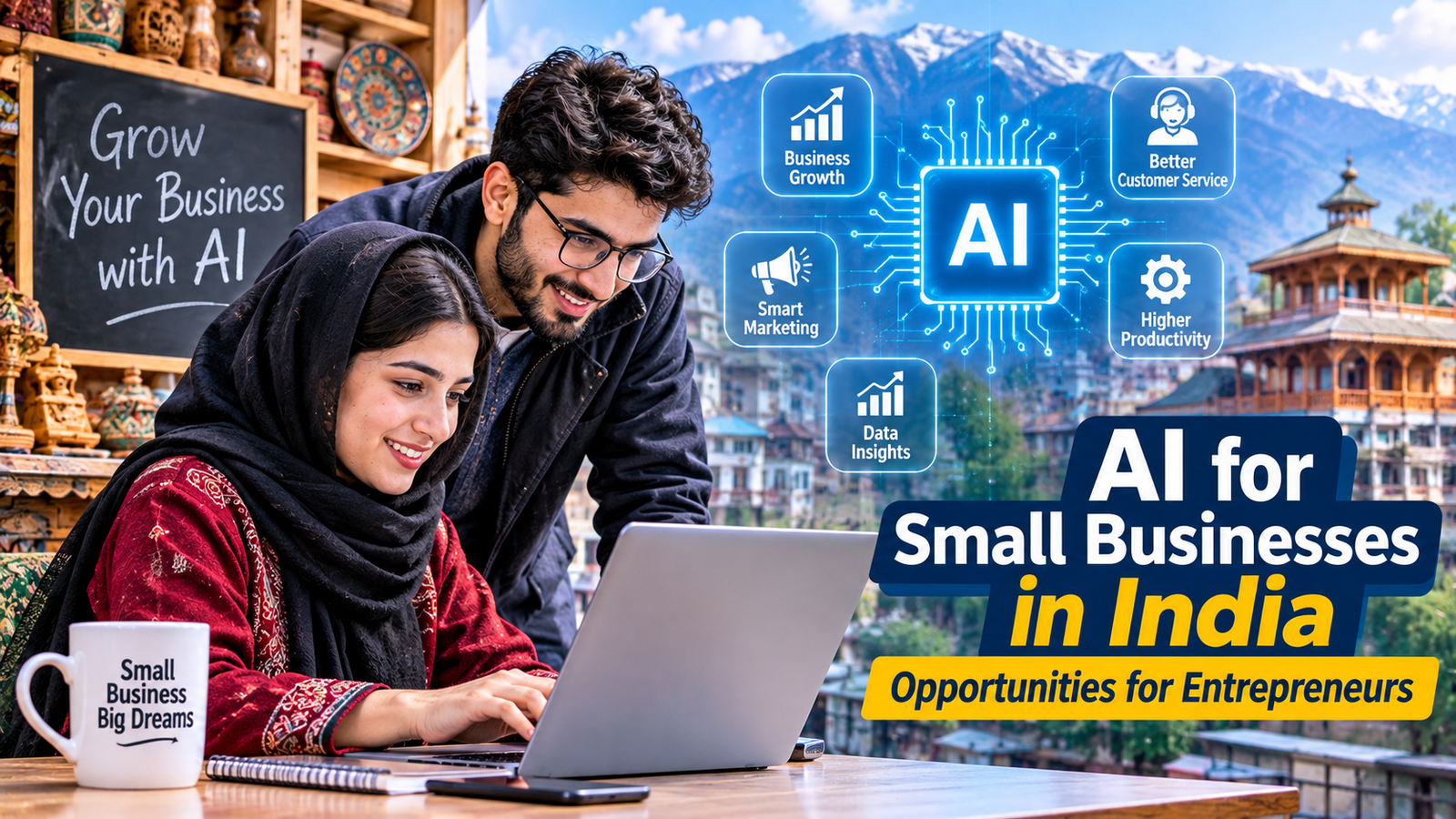
How Artificial Intelligence Is Changing the Way Small Businesses Operate: What Indian Entrepreneurs Need to Know

By Network KNT | Business & Technology
Artificial Intelligence (AI) is steadily changing how businesses communicate with customers, manage daily operations and make decisions. What was once considered a technology reserved for large corporations is increasingly becoming accessible to small businesses, startups and independent entrepreneurs.
For India’s Micro, Small and Medium Enterprises (MSMEs), AI presents an opportunity to improve productivity, reduce repetitive work and compete in an increasingly digital marketplace. From customer support and digital marketing to inventory management and data analysis, AI-powered tools are opening new possibilities for businesses with limited resources.
For entrepreneurs in Jammu and Kashmir, these developments could also create opportunities to reach wider markets, improve customer experiences and strengthen local businesses.
AI Is Becoming More Accessible to Small Businesses
Small businesses often operate with limited staff, budgets and time. Owners may be responsible for marketing, customer communication, accounts, sales and daily administration at the same time.
AI tools can assist with several of these responsibilities. Businesses can use AI-powered applications to draft product descriptions, prepare marketing content, organise information, analyse customer feedback and respond to common enquiries.
For example, a small clothing business can use AI to prepare product descriptions and social media captions. A travel company can use AI to organise customer enquiries and prepare itinerary drafts. A local retailer can analyse sales information to identify products that customers frequently purchase.
These tools do not eliminate the need for human decision-making. Instead, they can help business owners complete routine tasks more efficiently and spend more time on customers, product quality and business development.
How AI Can Help Indian Entrepreneurs
The practical applications of AI extend across different business sectors.
1. Digital Marketing and Content Creation
Marketing is essential for businesses looking to attract new customers. However, professional marketing campaigns can require significant time and resources.
AI writing and design tools can help small businesses generate content ideas, prepare draft advertisements, create social media calendars and develop product descriptions.
Business owners can also use AI to adapt promotional messages for different customer groups and platforms. However, all published material should be checked for accuracy, originality and brand suitability.
2. Customer Service and Communication
Customers increasingly expect quick responses to their questions. AI-powered chatbots and automated messaging systems can help businesses respond to frequently asked questions, share basic product information and guide customers through common enquiries.
For small businesses receiving enquiries outside normal working hours, automation can help maintain communication.
Sensitive complaints, payment disputes and complicated customer requests should still be handled by a responsible human representative.
3. Business Planning and Data Analysis
Making business decisions without reliable information can be difficult, particularly for smaller enterprises.
AI-powered analytical tools can help organise sales records, identify patterns, summarise customer feedback and prepare basic business reports.
A retailer, for instance, may use sales information to understand which products perform well during particular seasons. A service provider may examine enquiry records to understand which services attract the most interest.
The quality of the results depends on the quality of the information provided. Business owners should verify important findings before making financial or operational decisions.
4. Productivity and Daily Operations
AI can also support everyday administrative work, including drafting emails, preparing meeting summaries, organising documents and creating first drafts of business plans.
For businesses with small teams, these applications may reduce repetitive work and allow employees to concentrate on tasks requiring experience, judgement and personal interaction.
India’s AI Mission and the MSME Opportunity
The Government of India has identified artificial intelligence as an important area for technological development.
According to a Ministry of Micro, Small and Medium Enterprises announcement published by the Press Information Bureau on 30 July 2026, the IndiaAI Mission has an approved financial outlay of ₹10,371.92 crore. Its seven pillars include computing infrastructure, innovation, datasets, application development, future skills, startup financing and safe and trusted AI.
The government has also stated that the mission aims to make AI benefits more accessible, including to MSMEs.
This is an important development for businesses exploring digital transformation. However, entrepreneurs should distinguish between the broader objectives of the IndiaAI Mission and specific financial assistance programmes. They should check official eligibility requirements before applying for any scheme or benefit.
More information is available through the official IndiaAI Mission information portal and the Ministry of MSME updates published by the Press Information Bureau.
Opportunities for Businesses in Jammu and Kashmir
Jammu and Kashmir has a diverse business environment that includes tourism, handicrafts, agriculture, food processing, retail, education and professional services.
AI could support businesses in these sectors in practical ways.
Tourism operators could use digital tools to organise enquiries, prepare customised travel information and communicate with visitors. Handicraft businesses could improve online product descriptions and reach customers beyond local markets. Agricultural enterprises could explore data-based planning and digital information services.
Educational institutions and training providers could also introduce practical AI learning opportunities to help students understand emerging technologies.
These are potential applications rather than evidence that every local business has already adopted AI. The results will depend on infrastructure, affordability, digital skills and the specific needs of each enterprise.
Challenges That Businesses Must Consider
Despite its potential, AI adoption is not without challenges.
Cost and affordability: Some advanced tools require paid subscriptions, specialised systems or technical support. Businesses should begin with tools that address a clear operational need.
Digital skills: Employees and business owners need sufficient knowledge to use AI tools effectively. Training is important to avoid dependence on incorrect or unsuitable outputs.
Data privacy: Businesses should avoid entering confidential customer information, financial records, passwords or sensitive company documents into AI services without understanding their privacy and security arrangements.
Accuracy and reliability: AI systems can produce incorrect information, outdated claims or misleading answers. Important content, calculations and business decisions require human verification.
Overdependence on automation: Customer relationships often depend on trust and personal attention. AI should support communication, not remove the human element that makes a business valuable.
A Practical Starting Point for Small Businesses
Entrepreneurs do not need to transform their entire business overnight. A gradual approach can make adoption more manageable.
- Identify one repetitive task that consumes significant time.
- Explore an AI tool that can help with that particular task.
- Test it using non-sensitive business information.
- Check the quality and accuracy of its output.
- Compare the time, cost and results with the existing process.
- Train employees and establish clear rules for responsible use.
- Expand to other business activities only when the benefits are clear.
Small experiments can help business owners understand where AI provides genuine value instead of adopting technology simply because it is popular.
The Road Ahead
Artificial Intelligence is becoming an important part of the changing business landscape. For small businesses, its greatest value may lie not in replacing people but in helping individuals and teams work more effectively.
India’s efforts to strengthen its AI ecosystem, alongside growing access to digital tools, create opportunities for entrepreneurs willing to learn and adapt. For businesses in Jammu and Kashmir, the next step is to explore how these technologies can address real challenges in their respective industries.
The future of small businesses will depend on more than technology alone. Innovation, customer trust, responsible decision-making and the ability to respond to changing market needs will remain essential.
AI can provide useful support, but successful businesses will continue to depend on people who understand their customers and make informed decisions.
Further Reading and References
- Government of India: IndiaAI Mission
- Press Information Bureau: Government Promotes AI and Digital Technology Adoption to Boost MSME Productivity
- World Economic Forum: Transforming Small Businesses – An AI Playbook for India’s MSMEs
- NASSCOM: Enabling AI for MSMEs – White Paper
- Microsoft: Responsible AI Principles
About Network KNT: Network KNT covers developments in business, technology, education, entrepreneurship and other issues shaping communities and the wider world.