AllGPT.com Bets on Unified AI Access With Global Rollout and $4.99 Lite Subscription

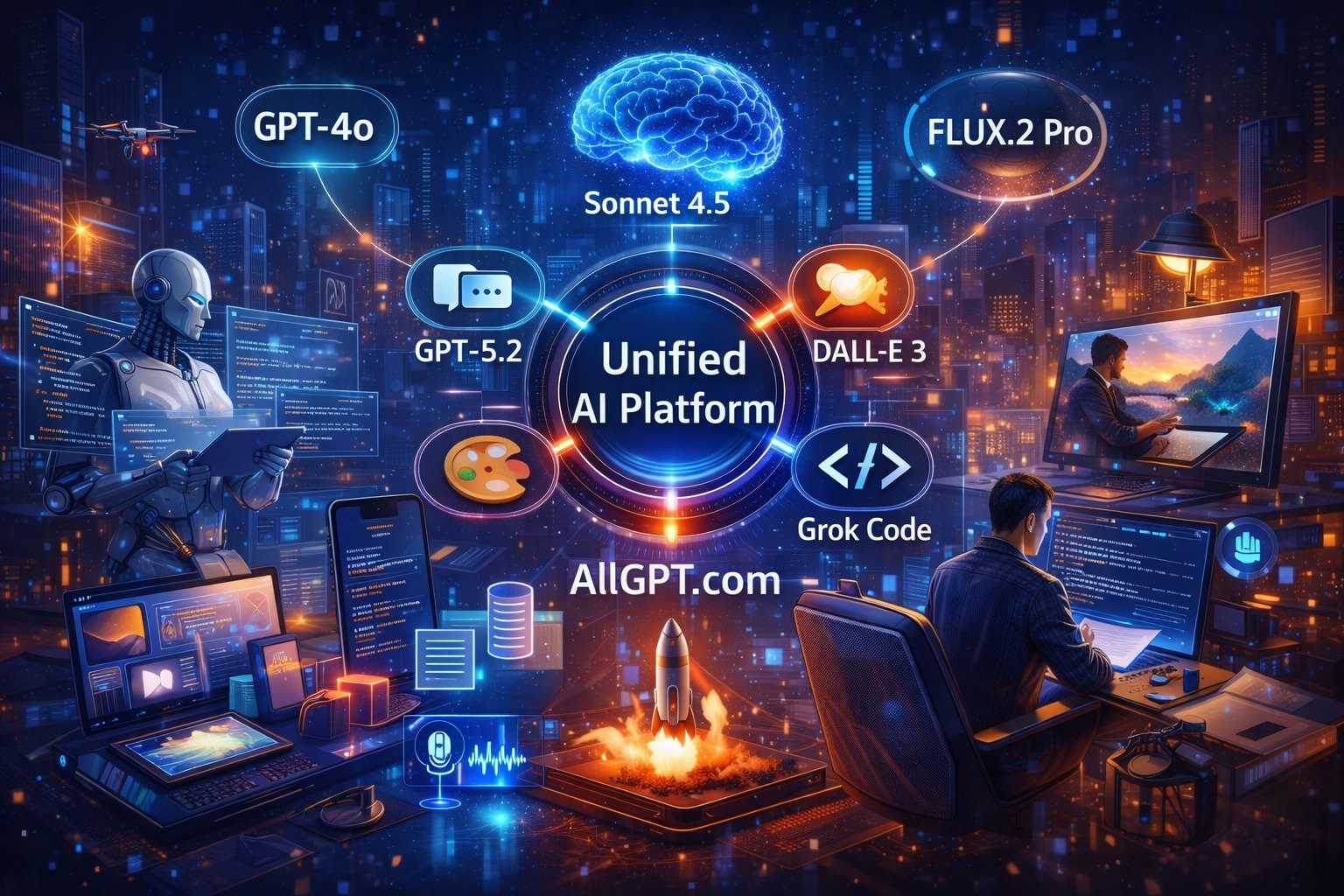
As artificial intelligence tools become more capable and more specialized, users across industries are facing an unexpected side effect of progress: fragmentation. Writers rely on one tool, designers on another, developers on several more, and teams often stitch together workflows across half a dozen platforms. AllGPT.com, a U.S.-based AI company incorporated as a Delaware C-Corp, is entering this crowded market with a different premise: instead of building yet another standalone model, it is bringing many of them together in one place.
Founded in December 2025, AllGPT.com positions itself as a global AI workspace that integrates over 100 AI models and tools across text, image generation, video creation, presentations, coding, and automation. The company says its goal is to reduce the operational burden created by managing multiple AI services, accounts, and subscriptions.
A Response to the Growing AI Tool Overload
The last two years have seen explosive growth in AI applications. While this has expanded what individuals and teams can do, it has also complicated how work gets done. Switching between platforms, reformatting outputs, and keeping track of usage limits has become a routine frustration for users.
AllGPT.com is built around consolidation rather than replacement. The platform provides access to a wide range of established AI models through a single dashboard and a single subscription. Users can move from writing to design to coding without leaving the workspace, an approach that mirrors how modern projects increasingly cut across multiple disciplines.
This model reflects a broader industry conversation about whether the future of AI lies in better individual tools or in better coordination between them.
Beyond Chat: Covering the Full AI Workflow
While chat-based AI remains a common entry point, real-world workflows now extend well beyond text. Visual content, short-form video, and multimedia assets are central to marketing, education, and digital publishing.
AllGPT.com incorporates video generation tools such as Sora2 alongside image generation models like Flux and Nano Banana Pro. Creative engines including King and Wan offer additional options for users looking to experiment with different styles or formats. By housing these tools together, the platform allows users to compare outputs and select the most suitable model without opening multiple applications.
This setup reflects how AI is increasingly used as a production layer rather than a single-purpose assistant.
One Interface for Image, Video, and Audio Creation
A key feature of the platform is its unified multimedia workflow. Users can generate images, test variations, and then move directly into video creation from the same interface. Side-by-side comparisons make it easier to evaluate quality, speed, and creative direction.
Audio and voice tools are also part of the ecosystem, supporting narration and voiceovers for videos, presentations, and other media. For content teams under tight deadlines, this reduces the time spent moving assets between tools and allows faster iteration.
Industry analysts note that such time savings, while incremental per task, can add up significantly across large content operations.
Productivity and Presentation Tools for Business Users
In addition to creative tools, AllGPT.com targets professional and business workflows. AI-powered presentation platforms such as Gamma are integrated to help users build structured slide decks for meetings, pitches, and internal reporting.
The advantage of this approach lies in continuity. Written content, visuals, and presentations can be created and refined in one environment, reducing the friction that often comes with exporting and reformatting content across software.
For remote and hybrid teams working across time zones, this kind of workflow integration can help maintain consistency and speed.
A Platform Designed With Developers in Mind
Developers are another audience AllGPT.com is actively courting. The platform includes coding-focused AI tools such as Grok Code and Claude Code, designed to assist with writing, debugging, reviewing code, and generating documentation.
What differentiates the offering is the proximity of these tools to non-technical AI features. Developers can plan features using text-based models, write code, and then generate documentation or presentations without switching platforms. This reflects how technical teams increasingly handle communication, documentation, and stakeholder updates alongside coding.
Early Scale and User Adoption
One of the company’s early milestones is the integration of more than 100 AI models and tools into a single platform. According to AllGPT.com, this breadth allows users to handle diverse tasks without maintaining separate subscriptions.
The company reports that it attracted around 20,000 users within days of launch, suggesting early interest in its unified approach. While still at an early stage, this level of adoption highlights growing demand for platforms that simplify AI access rather than expand tool sprawl.
Competing at the $5 Price Point
In a market where pricing can be a major barrier, AllGPT.com has introduced a Lite plan priced at $4.99 per month. The plan is positioned to compete directly with the $5 ChatGPT Go subscription but with a broader scope that includes image, video, coding, and presentation tools.
The company has emphasized that the Lite offering is part of a global strategy rather than a regional one. By matching a widely recognized price point, AllGPT.com aims to attract users who want more functionality without committing to multiple paid services.
Custom AI Agents and Data Portability
Recent updates to the platform include the ability for users to create and train custom AI agents. These agents can be tailored to specific roles or workflows, allowing more consistent outputs and reduced manual prompting.
Another feature drawing attention is chat history migration. Users can import past conversations from platforms such as ChatGPT, Claude, and Grok into AllGPT.com, preserving context and prior work. Data portability remains a key concern for users considering a switch between AI platforms, and this feature lowers that barrier.
Positioning in a Rapidly Evolving Market
The AI platform market is becoming increasingly competitive, with both specialized tools and large ecosystems vying for user attention. AllGPT.com is betting that integration and choice will matter more to many users than allegiance to a single model.
Whether this approach succeeds will depend on the platform’s ability to maintain stable integrations and adapt as new AI models emerge. For now, AllGPT.com represents a growing movement toward unified AI workspaces that prioritize simplicity, flexibility, and global accessibility.